 Proudly Canadian-owned company

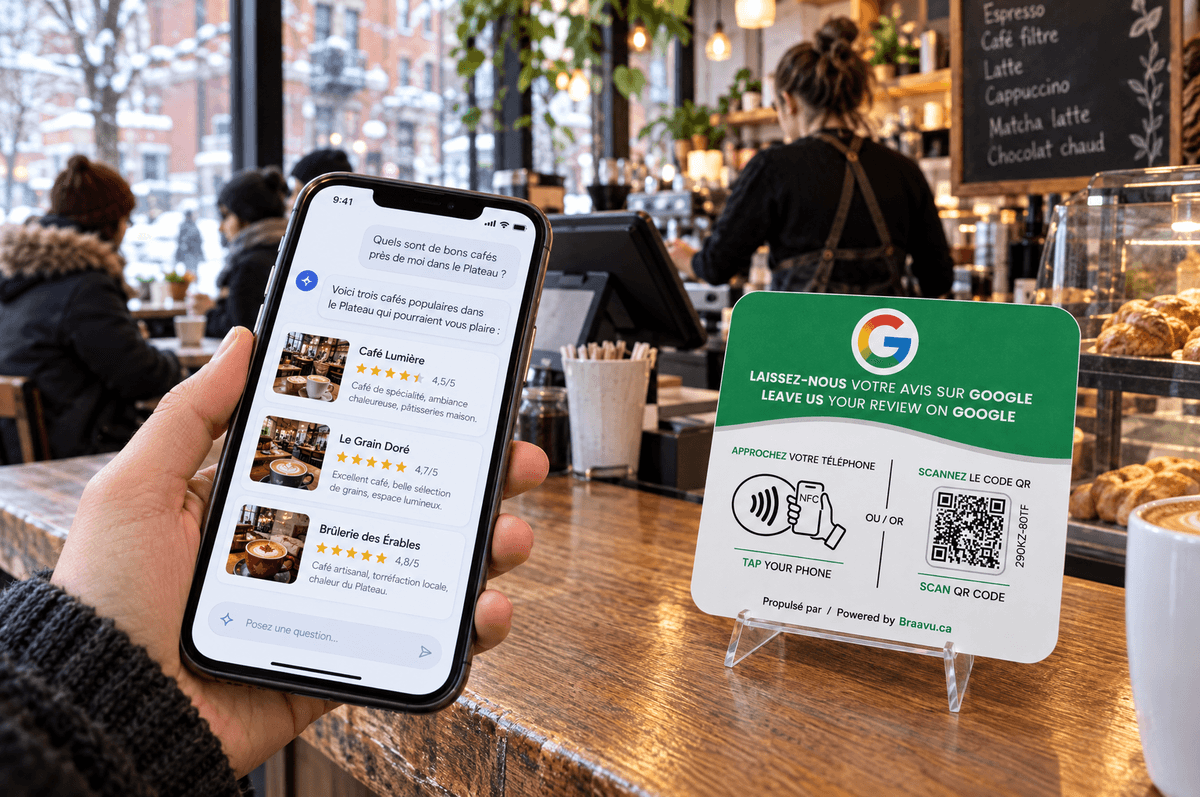
Yes, it already matters: many of your customers now put their question to an AI instead of Google. "A good café near me in the Plateau," "an honest mechanic in Mississauga," "a dental clinic open Saturday in Gatineau." The AI doesn't return ten links. It names three or four businesses, with a sentence for each. If yours isn't on that short list, the customer never sees it.
What the numbers say in Canada
This is no longer a niche habit.
- 46% of Canadians used a generative AI tool in the past year, and 52% of those users used it as a search engine, up from 35% in 2024. Source: CIRA, Canadian Internet Trends 2026.
- In Quebec, 52% of internet users have used a generative AI tool, and 84% of those users use ChatGPT. Source: ATN, NETendances, March 2026.
- In the United States, the share of consumers who asked ChatGPT or another AI for a local business recommendation went from 6% to 45% in one year. Source: BrightLocal, Local Consumer Review Survey 2026. That's US data, but the Canadian trend points the same way.
What about businesses? An Ottawa firm tested thousands of independent main-street businesses across nine provinces. ChatGPT named 44% of them at least once. The other 56% never appeared. Source: Clixera, 2026.
Search no longer works the same way
In classic Google results, sixth place was still visible. The customer scrolled, compared, clicked.
In an AI answer, there is no sixth place. There's the list, then nothing. The customer asks a follow-up ("which one is open now?") and keeps talking about the same names.
Three things change:
- The question is more specific. People no longer type "restaurant Halifax." They ask for "a quiet restaurant for a business dinner, with parking, near downtown." The AI looks for businesses that match each criterion.
- The AI summarizes what others say about you. It draws on your Google Business Profile, your website, your reviews, directories and articles that mention you. It doesn't read your ads.
- The customer trusts the selection. They've handed off the sorting. They won't go looking for what the AI left out.
Where AI gets its recommendations
Each tool has its own sources, but the same families keep coming back:
- Your Google Business Profile: category, hours, address, photos, reviews. Gemini and Google's AI features draw directly on Google Maps.
- Reviews: how many, the rating, how recent, and what they say ("fast service," "great for kids").
- Your website: what you do, where, and when, in readable text.
- Other sites that mention you: directories, business improvement areas, local press, platforms like Yelp or Tripadvisor.
Nobody has published the exact formula. But one point comes up in every study and in Google's own guidance: a business that many recent customers describe positively is easier to recommend.
Where to start
No need to redo everything. In order:
- Check your Google Business Profile. Is it claimed, complete, with the right hours? See how to claim and verify it and how to optimize it.
- Get recommended by AI. The details, including the role of reviews: how to show up in AI answers.
- Go tool by tool. Gemini and Google, Claude, Microsoft Copilot, Perplexity, Meta AI, Grok, and ChatGPT's new business listings.
- Test it yourself. Ask ChatGPT, Gemini and Claude the question a customer would ask. Write down who shows up. Try again in a month.
Where Braavu fits
Google reviews are one of the few signals you control day to day. What matters most is that they keep coming in, not in a burst once a year.
Braavu sells an NFC and QR counter plate. The customer taps a phone, or scans the code, and the page to write a Google review opens. That address is built from the Google listing you chose: no other link can be pasted in. From the dashboard, you change the listing for a location, and every active plate at that location follows, without a reprint. The plate does not open Instagram, Facebook, TikTok, WhatsApp, a menu or a link-in-bio.
Bottom line: AI doesn't list ten businesses, it names three or four. A complete Google Business Profile and recent reviews are the foundation for being one of those names.