 Proudly Canadian-owned company

Gathering Google reviews is good for a local business. But privacy rules have tightened across the US in recent years, and plenty of owners now wonder where the limits are. Good news: asking for a review is still completely allowed. The real question is how you handle personal information along the way — the heart of collecting customer reviews and US privacy law.
Here's a plain-language tour, no legal jargon.
US privacy law in two minutes
There's no single national privacy law in the US the way Europe has one. Instead, a growing patchwork of state laws sets the tone. California's CCPA/CPRA is the best known, and states like Virginia, Colorado, and Texas have passed their own. Broadly, they all point the same direction: if your business collects, uses, or stores information about people — a name, an email, a phone number — you're expected to be transparent about it and to respect people's choices.
A Google review published publicly isn't, by itself, information you hold. The customer publishes it on their own Google account. You store nothing. That distinction is where the nuance lives.
When your practices touch privacy law
Obligations kick in the moment you collect information to solicit a review. For example:
- You gather emails to send a review request.
- You keep a list of customers to follow up with.
- You use a tool that records contact details.
In those cases, a few habits matter:
- Be transparent. The customer should know why you're taking their email and what you'll do with it.
- Use it for the stated purpose. Data collected for a receipt doesn't automatically become a marketing list.
- Minimize. Collect only what you truly need.
- Limit retention. Don't keep a list forever.
- Honor requests. Under laws like California's, people can ask to see or delete what you hold — and you may need to offer an opt-out.
The simplest approach: collect nothing
The lowest-risk method is also the most direct. If the customer goes to Google themselves and publishes their review, there's no database on your side, so there's no data to protect.
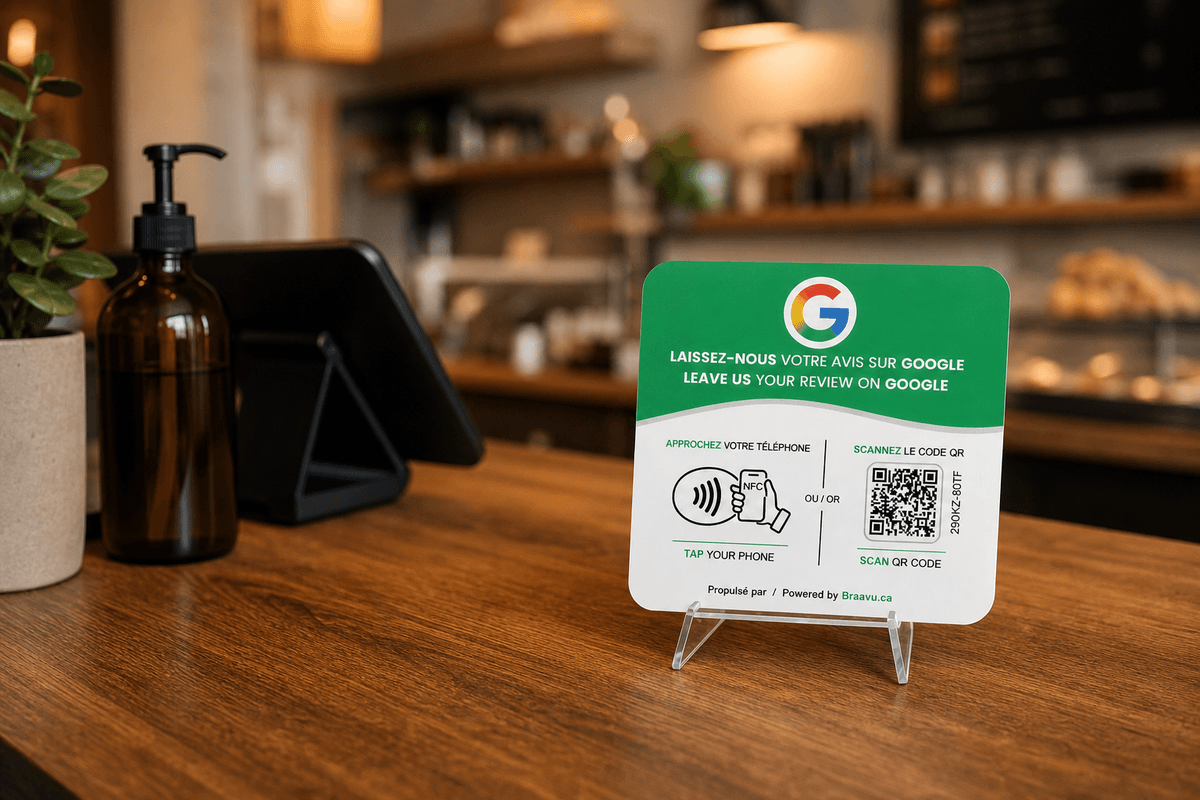
That's exactly the logic of a review plate (also known as a Google review stand) on the counter. The customer taps their phone (NFC) or scans the QR code, and the Google review page opens. They decide, they write, they publish. You have no email, no list, no automated follow-up.
No collection, no friction with privacy law. The action stays voluntary and public.
The data upside is simple: the customer taps, they land on the Google review page, nothing is stored on your side. It's a clean way to stay active without adding to your obligations.
Good habits to keep
Even with a no-collection approach, keep these principles in mind:
- Never buy or fabricate fake reviews. Google bans it, the FTC treats it as deceptive, and it hurts your credibility.
- Don't gate customers to send only the happy ones to Google. The ask must be open to everyone.
- If you do use email or a CRM, document consent and set a retention window.
Privacy law isn't a roadblock. It's a framework that rewards businesses that stay transparent with their customers.
Braavu sells one plate, NFC and QR. It opens the page to write a Google review for the listing you chose. Change that listing for a location, and every active plate at that location follows, without a reprint.
Takeaway: Asking for a Google review is allowed everywhere in the US. The privacy risk comes from what you collect and store. A plate that opens the Google page directly, storing no data, is the simplest option. This is general information, not legal advice — talk to an attorney about your specific obligations, especially if you serve California or EU customers.